Expertise



| Programming | Gameplay, UI, Inverse Kinematics and general frameworks. |
| Rendering | Shaders, Render Pipeline, Compute Shaders, etc |
| Tooling | For asset integration, porting, level generation, etc. |
| Optimization | Anything from code to graphics, especially for consoles (like Nintendo Switch) |
| Engines | Unity, Unreal 5 & Godot |
| Programming Languages | C#, C/C++, Python, GDScript, Javascript |
| Shader Languages | HLSL, GLSL, Shader Graph, UE Materials, Godot Shaders |
| Version Control | Git (CLI, SourceTree, Fork, etc.), SVN (TortoiseSVN) |
| Project Management | Jira, Confluence, Trello |
Unity
Unity is without a doubt the engine I have the most experience with. At time of writing, all of the shipped games I've worked on, have been implemented in Unity. Most of my University projects were too. The other two engines, I worked on either as R&D for the companies or in my personal time. Here's a non-exhaustive list of video game development areas I've actively worked on in Unity:
- Gameplay Implementation
- Character Animation & Inverse Kinematics
- UI Programming, Animation & Effects
- Optimization
- Rendering & Shaders
- Behaviour Trees
- Agent Navigation
- Cinematics
- Frameworks
- Tools
I've worked on a great variety of aspects of game development, which has allowed me to learn and use a useful set of packages and tools that make Unity development easier and more seamless.
As such, I have extensively used:
- Addressables for loading content dynamically and asynchronously.
- The New Input System which works much better than the old one (especially for consoles).
- The Animation Rigging package for Inverse Kinematics.
- The Localization package together including its Google Sheets integration.
- Scriptable Render Pipelines, especially URP and for Custom Render Passes.
- Cinemachine, for managing cameras and transitions easily.
- The Jobs System for parallelizing tasks to take advantage of the CPU Cores.
Given that I've worked as a Technical Art Lead and a Graphics Programmer for around 4 years, I've dabbled into a lot of rendering stuff. Specifically, I have:
- Implemented shaders in HLSL, Amplify Shader Editor and Shader Graph.
- Developed Compute Shaders for water shaders and other highlyJobs System parallelizable workflows.
- Adjusted existing and added custom Render Passes.
- Configured Post-Processing Volumes, and even implemented blending of Post-Processing effects that can't blend by default.
- Set up Shader Stripping, to reduce compile times, build size and memory usage.
- Used Visual Effects Graph and Shuriken Particle Systems, though I'm not really an experienced VFX Artist.
- Created tools for ensuring asset compliancy (valid material properties, null materials in MeshRenderers, etc.).
Godot
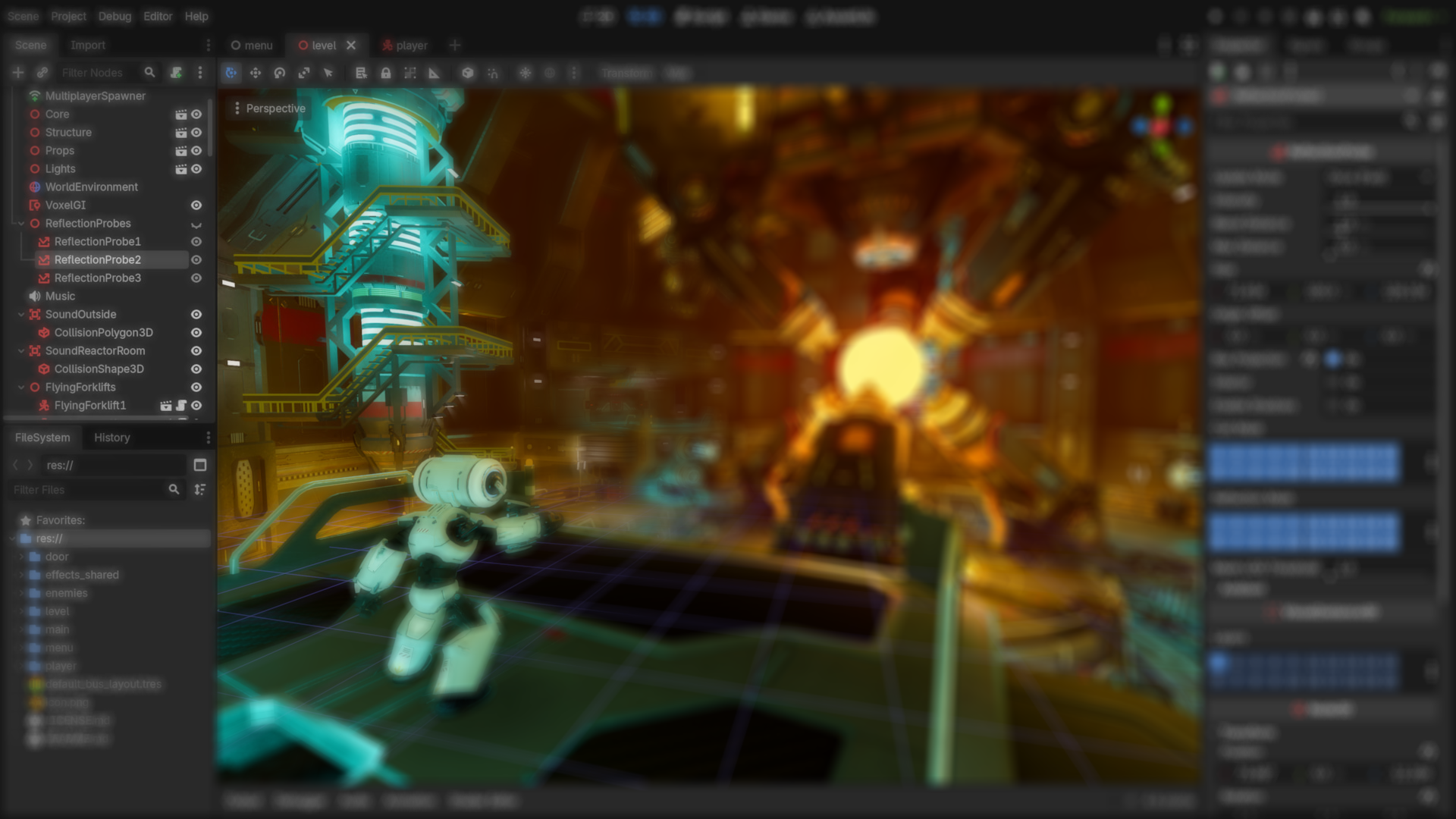
I've been following the development of Godot for a few years now. Though I haven't had the chance to use it professionally yet, I have worked on several personal projects with it.
🫙 Most notably, I made a small video game for the Brackeys Game Jam 2025.2, which you can read more about in this article.
🌍 I've also made a small demo that replicates the gravity fields of the Super Mario Galaxy games, where planets can have non-spherical shapes. I haven't polished the demo visually enough for public viewing, but I plan on releasing it some day.
🦇 Additionally, I'm making a small game about counting bat populations, as I have a friend who does volunteer work on that topic. The idea is to make a small game that gamifies the experience and motivates new people to volunteer, in order that bat population studies can be done. I'm not sure about the release date yet, but I'm trying to release it as soon as possible.
I'm a big fan of Godot and its community and I think it's going in a great direction. I expect it to keep growing until it becomes the "Blender" equivalent of Game Engines.
Unreal Engine
On one of my previous jobs, I was assigned to do R&D into Unreal Engine 5. I developed a new project in which we wanted to try out its technologies and see how viable it was to transition to it for future projects.
During that time, I had the chance to work on Nanite, Lumen and Virtual Texturing, among other things. I have also used Blueprints for implementing game mechanics and level logic. For prototyping, I have used its integrated Modeling Tools. Also Material Blueprints for shader programming.
I've also collaborated with my talented and dear friend, Guillem Serra , on his own video game called A demiurge's soliloquy . There, I've done some Shader and UI work.
All trademarks, logos, and brand names are the property of their respective owners. Any mention of company, product, or service names is solely for identification purposes.